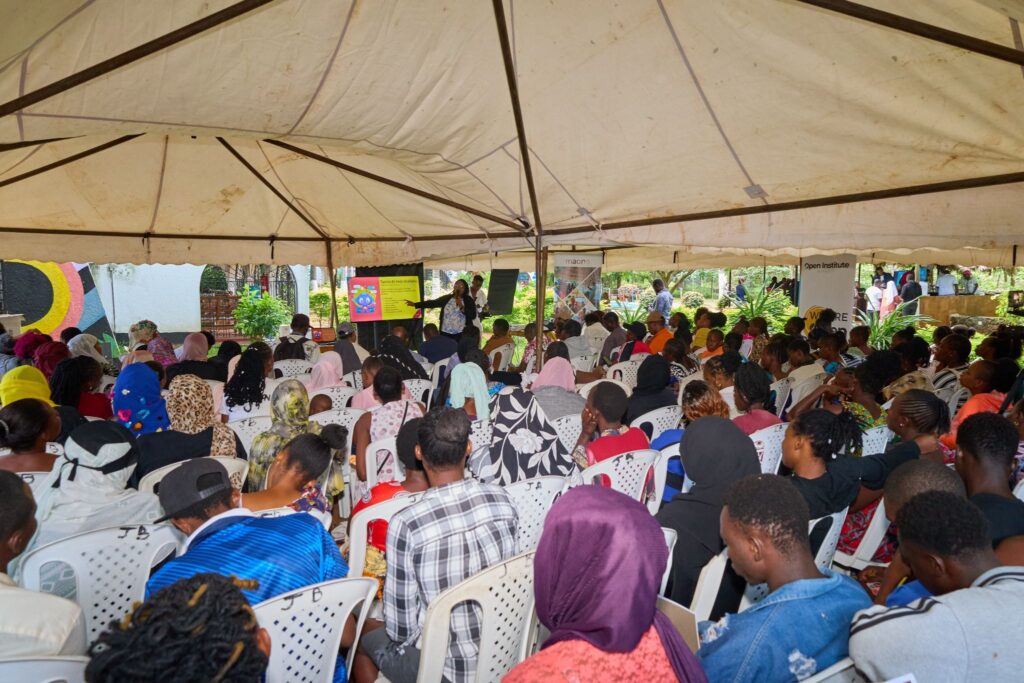

In Kilifi County, Kenya, the digital transformation is already happening. But not everyone is moving at the same pace.
For many people, especially those working in grassroots communities, the challenge is not a lack of interest in technology. It is access to the resources, equipment, information, and skills needed to make technology useful in their everyday lives. In some schools, for example, teachers have limited access to technology that could support their work, while learners are increasingly encountering digital tools outside the classroom.
At Maono Space, we have been asking a simple question: What does it take to make sure grassroots communities are not left behind in the age of AI?
This question has shaped AI Mtaani, a programme that takes practical AI learning closer to communities that are often left out of conversations about emerging technology.
Starting the AI Conversation in Kilifi
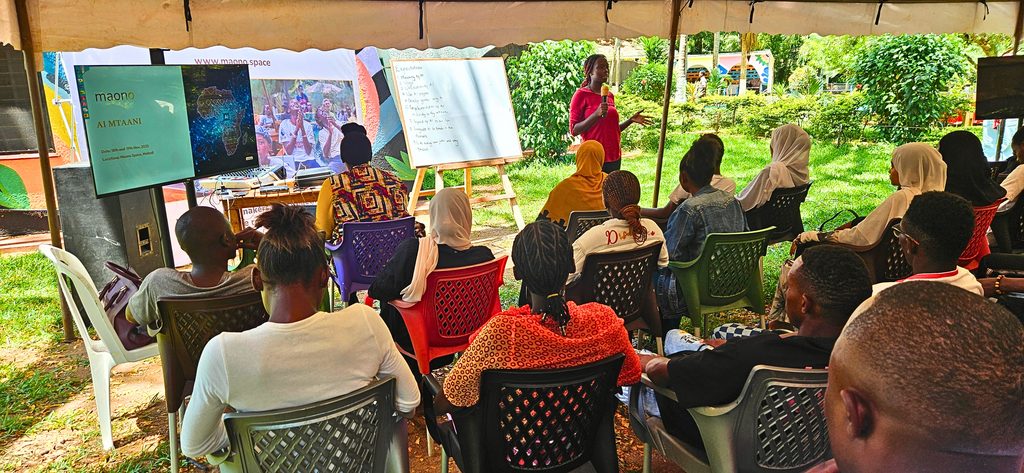
We launched the AI Mtaani programme in November last year, bringing together people from across Kilifi County to begin exploring what AI means for their lives and work.
The intention was not simply to introduce another technology. It was to create a space where people could become curious, ask questions, and understand how AI could be applied to the realities they face every day.
In March, we took the conversation further through AI Mtaani: Biashara Edition 1, bringing together more than 129 SMEs to explore how AI could support their businesses. Participants experimented with tools such as Gemini and explored practical applications, including content creation, customer communication, research, and developing business ideas.
In July, we held AI Mtaani: Biashara Edition 2 that brought 160 SMEs to continuing the conversation with businesses in the grassroots.
Across the two editions, one thing became increasingly clear: people were interested in AI, but many needed practical guidance to understand how to use it effectively. Having access to an AI tool did not necessarily mean knowing how to communicate with it, assess its responses, or understand its limitations.
The demand was becoming clear: grassroots communities wanted to learn about AI, and they wanted that learning to connect to the work they were already doing.
This led us to take the conversation into another important part of the community: education.
Taking the Conversation into the Classroom
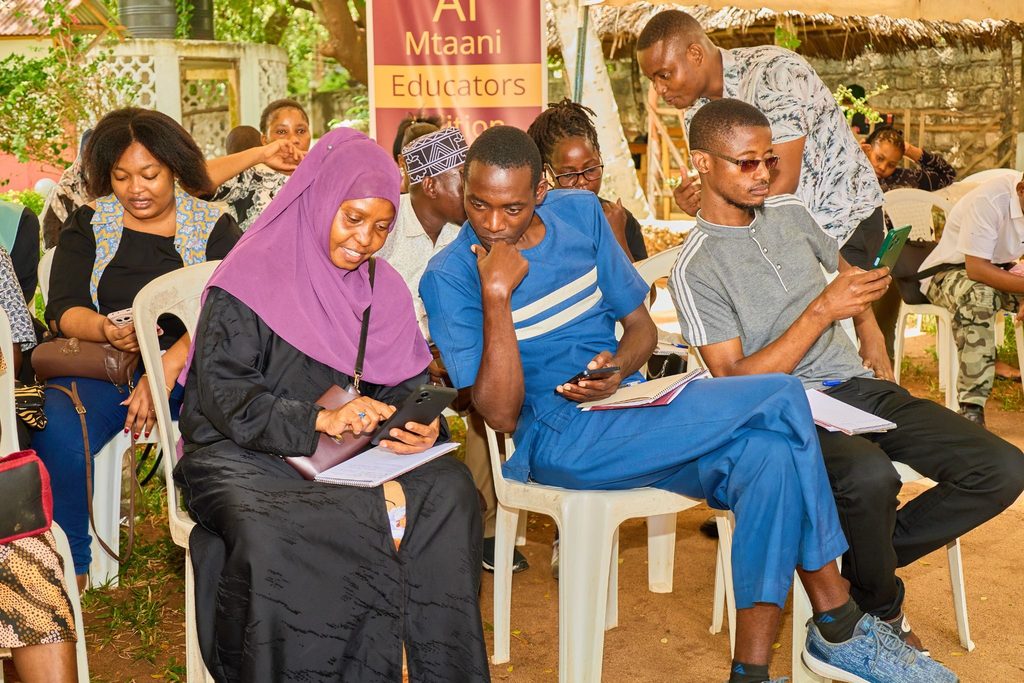
On 5 September, we extended AI Mtaani into education through AI Mtaani: Educators Edition, bringing together more than 68 teachers for a practical session on AI and its application in education.
The teachers arrived with different levels of experience. Some had never interacted with AI tools before, including Meta AI, which is available through WhatsApp. Others were already using ChatGPT, which was the most familiar AI tool among many participants. But the training revealed an important distinction: using AI and knowing how to work with it effectively are not the same thing. Some teachers were already using ChatGPT but had not explored how to give clear instructions, generate useful responses, or critically assess the information produced.
To address this, the teachers were introduced to The NANI Prompt Formula, a simple four-step approach designed to help them communicate more effectively with AI and receive more accurate and useful responses.
The formula focuses on four key elements: Role, Context, Task, and Format.
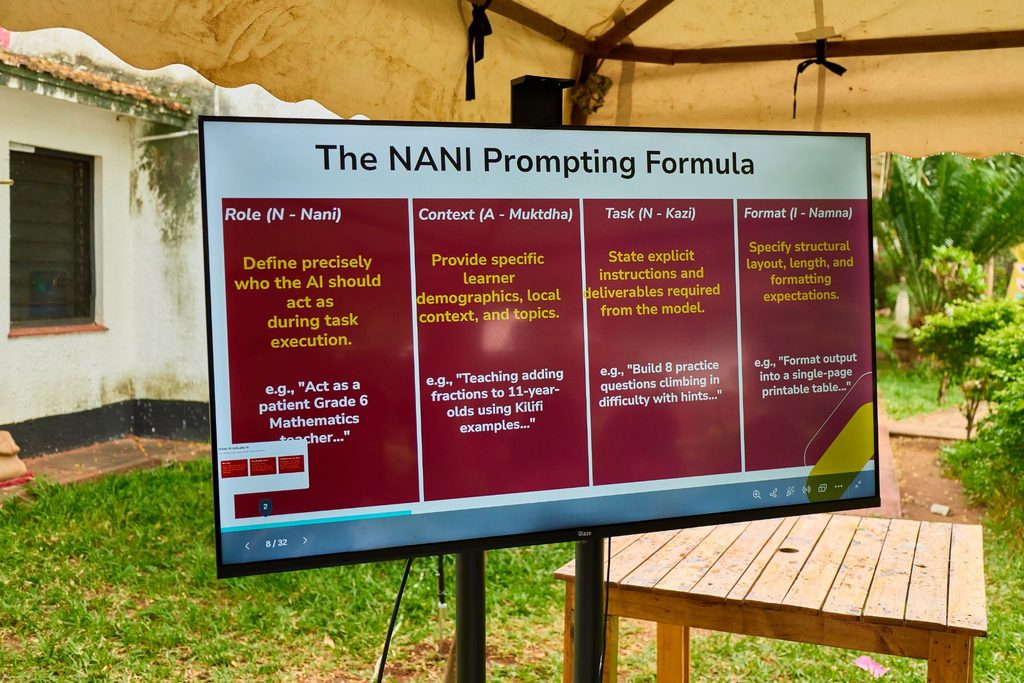
Instead of simply asking an AI tool a general question, teachers learned how to tell the tool what role it should take, provide the relevant context, clearly explain the task, and specify the format in which they want the response. This was particularly useful in demonstrating how AI could become a practical assistant rather than simply a tool for asking questions.
Teachers explored how they could use AI to support lesson planning, develop teaching and learning materials, and prepare schemes of work aligned with the Kenyan curriculum and the Kenya Institute of Curriculum Development (KICD).
Throughout the training the message was AI is not a replacement for the teacher but a tool that complement the work teachers already do.
The teacher remains responsible for providing context, guiding the tool, reviewing its responses, correcting inaccuracies, and ensuring that the final material is appropriate for learners and aligned with the curriculum. The conversation became even more relevant when some teachers shared that their learners were already using AI more frequently than they were, particularly while at home.
This raised an important question: If learners are already interacting with AI, how prepared are teachers to guide them through its opportunities and risks?
When Curiosity Became Part of the Learning
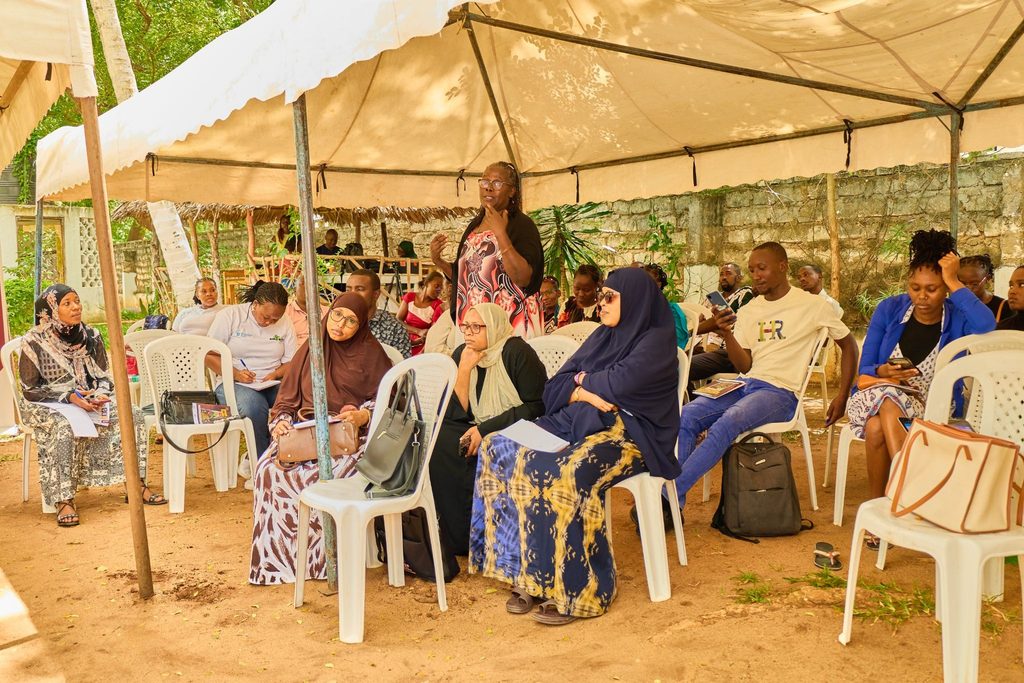
The training was not a one-way conversation. As teachers interacted with AI tools, their questions revealed how they were beginning to make sense of the technology.
One participant, Eunice Muratha, was particularly active throughout the session. She asked question after question, exploring AI from different angles. At one point, she asked:
“How does AI get information about me?”
She also asked whether AI is demonic and questioned whether AI has a gender identity, observing that some of its responses sounded as though they were coming from a man.
Her questions opened the door to a deeper conversation about how AI works.
In response to her question about how AI could appear to know something about her, the discussion explained that many AI services require users to create accounts, and information associated with an account or shared during interactions may be used by the service in different ways, including personalisation, depending on the tool and its settings. The information a person provides and the way they interact with an AI system can also influence how the system responds.
This helped address the perception that AI somehow automatically knows everything about a person.
The conversation around gender also created an opportunity to explain that AI itself does not have a biological gender identity. However, its responses can sometimes appear to have a particular personality, tone, or voice depending on how the system is designed, the instructions it receives, and how the user interacts with it.
Eunice’s questions were not interruptions to the training. They were part of the learning.
They showed the importance of creating spaces where people can question new technologies openly, test their assumptions, and leave with a clearer understanding of what these tools can—and cannot—do.
From Using AI to Using It Responsibly
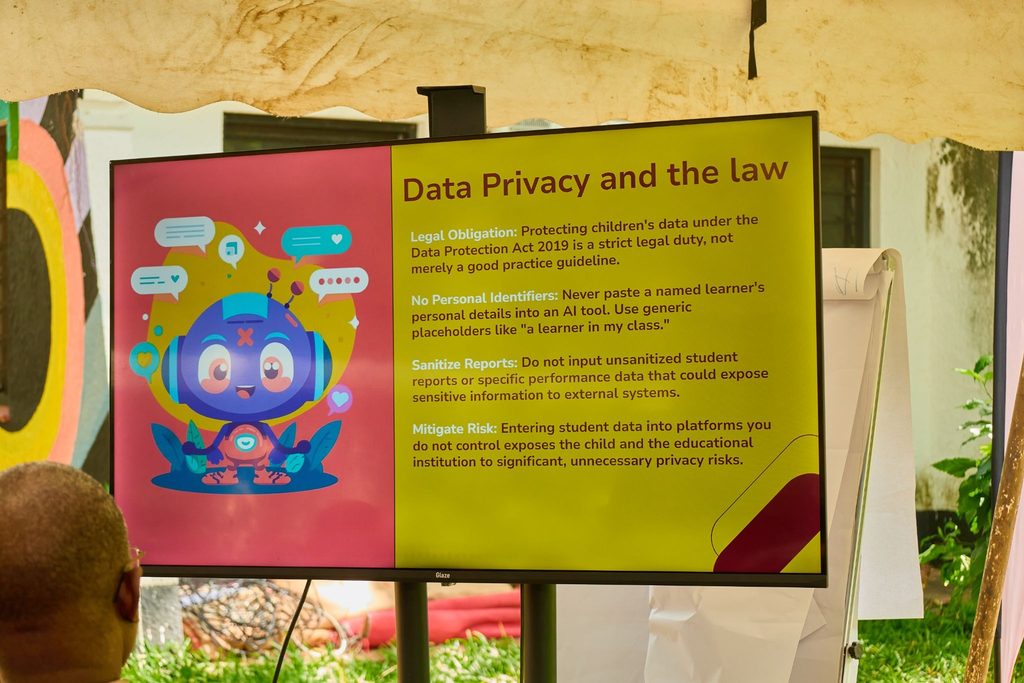
As the training progressed, the conversation moved beyond prompts and practical applications to another important issue: data protection and AI ethics.
The facilitator asked the teachers:
“Is your school registered with the Office of the Data Protection Commissioner (ODPC)?”
Many were unsure. Some had little or no knowledge of the ODPC or its role in protecting personal information. This opened a broader discussion about learners’ data.
Teachers highlighted situations where some schools use learners’ information and even their identities for marketing, promotion, reporting, and other communication activities. This raised important questions about how schools collect, store, use, and share learners’ personal information.
The issue becomes even more important as AI becomes part of teaching and school administration. A teacher may use AI to develop a lesson plan or create learning materials, but what happens if personal information about a learner is included in the process?
What information should be shared with an AI tool?
What information should remain private?
How should learners’ personal information be protected?
From the discussion, it was clear that using these tools well also means knowing when to pause, question, and protect the information we handle.
For educators, this is as much about responsible practice as it is about technology.
What the Training Revealed
The Educators Edition showed that the challenge is not simply whether people have access to AI tools. It is what happens once those tools arrive in their hands.
Some teachers were encountering AI for the first time. Others were already using ChatGPT but discovered new ways of working with it. Some were introduced to tools available through platforms they already use, while others began thinking more deeply about privacy, ethics, and the implications for their learners.
The teachers’ experiences also showed that the conversation around AI is already happening among learners. Some educators noted that their learners were using AI more frequently than they were while at home.
This creates an important role for teachers. They need to be familiar enough with these tools to ask the right questions, recognise potential risks, and help learners make informed choices.
The training also demonstrated the value of creating spaces where people can ask questions without fear of being judged.
Eunice’s questions—from how AI knows about her to whether it has a gender identity—were a reminder that people come to new technologies with different experiences, assumptions, and concerns.
The starting point is not having all the answers. It is having a space where people can ask the questions.
What Comes Next?
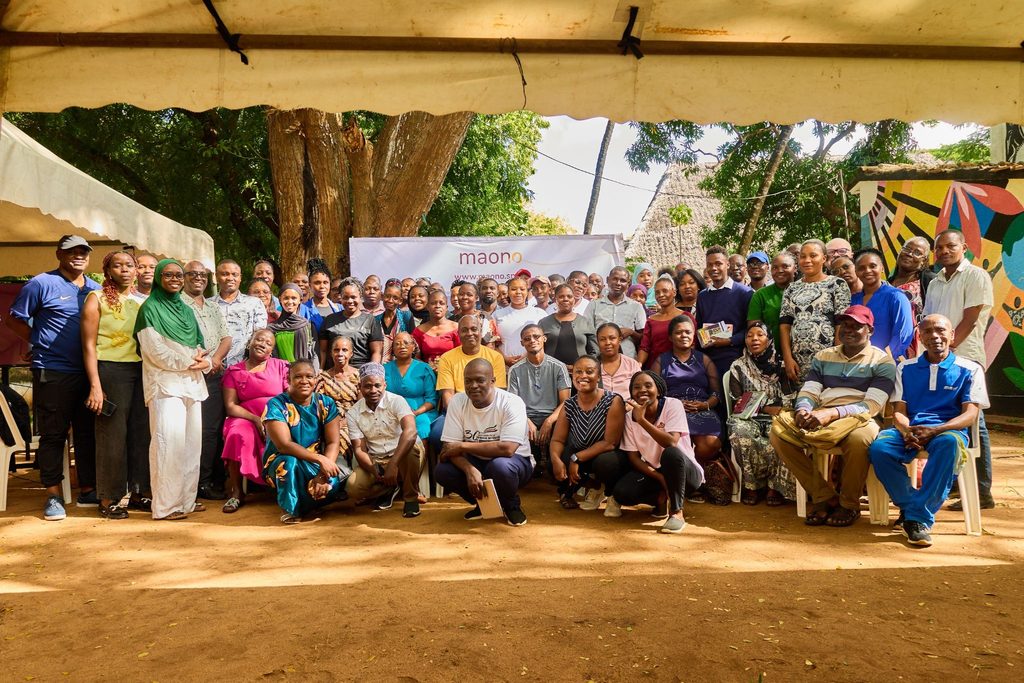
The journey from the launch of AI Mtaani, through Biashara Edition 1 and 2, to the Educators Edition has shown us that the interest in AI extends across different sections of grassroots communities.
Businesses are exploring how AI can support their work. Teachers are looking at how it can complement teaching and learning. Learners are already interacting with AI.
The next step for AI Mtaani is to build on these conversations, to reach more communities, deepen practical learning, and create opportunities for people to continue experimenting with AI while understanding its ethical and social implications.
With the right support, AI Mtaani can grow beyond individual training sessions into a sustained pathway for communities to engage with AI in ways that are practical, responsible, and relevant to their everyday realities.
The opportunity is not simply to teach people about another emerging technology. It is to ensure that communities that have historically had less access to technology are equipped to participate in shaping how AI is used in their own lives, workplaces, schools, and communities.
At Maono Space, we believe the future of technology should not be shaped only in boardrooms, technology hubs, or major cities. The people and communities on the ground must also have a place in that future.
The AI conversation is already happening.
Our next step is to make sure the grassroots are part of it.